
Reflection and Review: Crying in H Mart by Michelle Zauner
A masterful memoir connecting food, family, and loss. Includes a 12-minute oral review episode.

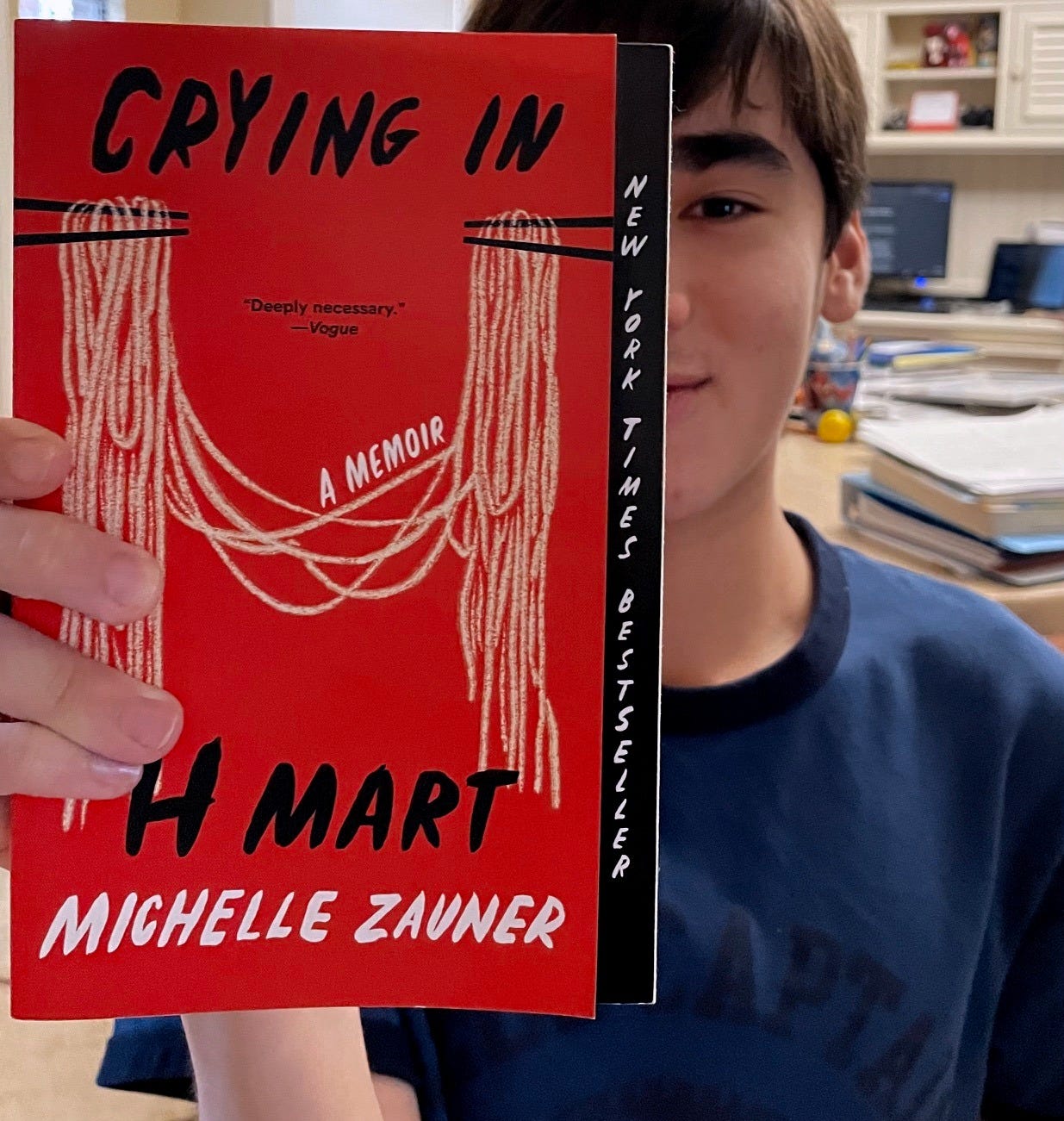
I’ve recorded an audio-only review of this book in podcast format, available to listen to on Soundcloud or via the widget below. It’s approximately 20 minutes long and reflects on similar topics to the blog.
From the first sentence of Crying in H Mart’s opening chapter, I knew it was going to be a wild and emotional ride. It was the kind of opening that instantly makes you want to keep reading. Why is the narrator crying in H Mart? What are the origins of these feelings? And, over the course of the book and its pungent, passionate unraveling, we are not disappointed in any way. Zauner has found a way to weave the themes of food and the comfort it provides together with family, loss, and grief—creating a powerful, charged story that’s altogether unforgettable.
I had read an excerpt of this chapter for an English class assignment a few years back, and was immediately captivated by the narrative’s intensity. But now, revisiting the book in its complete form, I found I was able to better appreciate its full story and the cohesive emotional picture it painted. The book’s pacing is masterfully planned: we get a slow yet detailed introduction to the narrator, her shaky employment situation, and her close relationship to her mother. A common sign of a well-developed and comprehensive narrative is a strong focus on the narrator’s early life; in the first few chapters we get some key insights into Zauner’s childhood in Eugene, Oregon.
Unlike the standard multi-lingual narrative, which pastes a robotic translation directly after each foreign phrase, Crying in H Mart leaves many Korean foods and words in their original phonetic form. Occasionally, when needed, there’s a brief translation or interpretation of the phrase. But most of the time, it’s left up to the reader to discern the meaning from context clues—adding ambiguity, tension, and sophistication.
Near the end of chapter five (still in the developmental section of the book), Zauner shares some important details about the way her family viewed her interests as an adolescent. “‘I should have never let you take guitar class,’” Zauner’s mom says at a restaurant. This marks a crucial division in the narrator’s ambitions: go to college and leave behind her dreams of becoming a professional musician, as her mother wishes, or defy her parents and go on tour? This balloons into a larger argument—one that sets the bittersweet tone and relationship that dominates the next few chapters—and nearly ends in physical violence.
The tension and long years of semi-estrangement between Michelle and her mother are what make her mom’s sickness so much more emotionally provocative and passionate. Just months before the onset of her mother’s illnesses, Michelle regains friendly contact with her, returning to the close relationship they had shared before the adolescent crises. Yet this happy reunion of sorts is cut short by the stage 4 pancreatic cancer, which comes on almost out of the blue and rapidly begins taking its toll on her mother. As the illness grows worse and worse, Michelle finds herself facing the possibility that her time with her mom may be drawing to a close.
The remaining chapters of the book, those leading up to the day of Michelle’s mother’s death, are punctuated by flashbacks to the past and fleeting final trips to Korea. Meanwhile, I was surprised at how the narration remained clear-headed and concise even through the author’s most tumultuous days, the mood switching back and forth between hopeful patches of light and solemn squalls of darkness and despair. The pacing of the story is controlled carefully and deliberately, and it’s almost as if you’re living through the sometimes-miserable, sometimes-carefree days yourself.
And then it happens so suddenly, you’re forced to re-read the paragraph, the entire page, to make sure you didn’t miss anything. Following an unexpected burst of pain, the narrator’s mother enters a liminal state of unconsciousness before silently passing away. The shocking transition from tense narration to all-out grief and sadness, I think, is what makes the last half of Crying in H Mart so pungent and unforgettable. In this book, Zauner has achieved what every memoir can only dream of: making the reader feel as if they are the narrator, as if they are the ones experiencing everything unfolding in the book.
Upon reflecting on my reading experience with Crying in H Mart—and over the course of the oral review at the top of this post—I discovered several key elements of why I think the book was so successful: connection, humility, and tension. The narrator didn’t try to downplay their grief or make their loss seem more dramatic or emotional just to grab attention; it’s clear that Crying in H Mart is a brutally honest retelling of a catastrophic loss.
This was another wonderful read, and I strongly recommend it. If you’ve read it, let me know what you think about it in the comments.
I can’t wait to read this book. Your review really conveyed the emotional impact of this memoir, along with your excellent discussion of structure and theme. I agree with you, memoir is at its most effective when the reader really makes that emotional connection with the writers experience. I read a lot of memoir, and I most enjoy those that offer the reader deep connection like that.